

Designing Learning That Lights the Way.
Interactive Learning Experience Samples
-
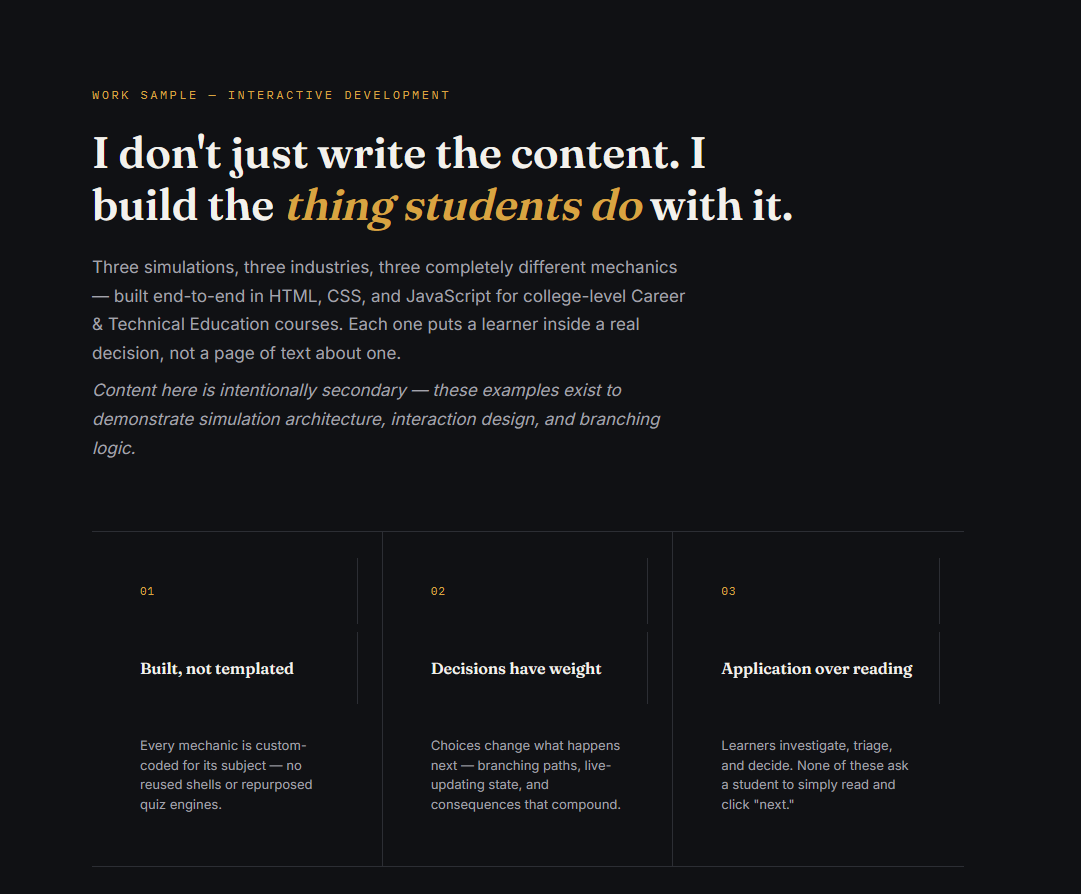
Simulation Design Across Three Industries | Health Science, Construction & Cybersecurity | Branching, Decision-Based Interactive Simulations
Most interactive activities are built once and reused everywhere, the same click-through mechanic wearing different content.
These three simulations are the opposite: three completely different interaction models, each built from scratch for the industry it represents, because a newsroom deadline, a jobsite change order, and a live ransomware incident don't behave anything alike.
In health science, learners chase a live broadcast deadline as an investigative reporter, evaluating conflicting sources under real-time pressure before a story airs.
In construction, they hold a framing spec against two live Change Orders, learning fast that an answer that worked before doesn't survive a scope change without a recheck.
In cybersecurity, they command a live ransomware incident, watching two damage meters shift in real time as each decision compounds toward one of several possible outcomes.
All three are built in HTML, CSS, and JavaScript. Step into all three and see how differently each one plays out. Explore the simulations live.
-
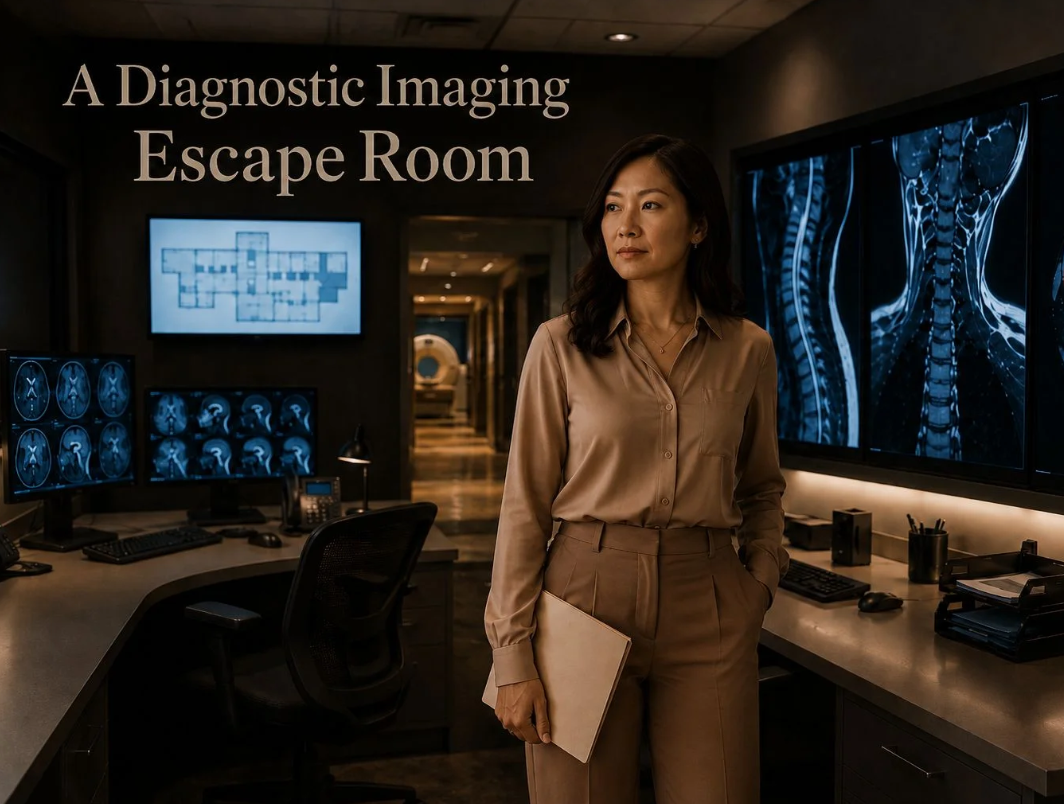
Simulated Clinical Decision Environment | Health Science / Radiologic Technology | Lock-Based Diagnostic Reasoning
This interactive learning experience replaces the traditional static case study with a real-time, consequence-driven diagnostic simulation built using AI voice (ElevenLabs) and avatar (HeyGen) technology.
Learners step into the role of a Diagnostic Imaging Specialist at a regional medical imaging center, managing a live trauma case, a patient presenting with a suspected cervical spine injury, under a five-stage, lock-based decision structure.
Rather than answering questions about imaging modalities in the abstract, learners must select the correct diagnostic technology at each stage of care, receive immediate AI-voiced clinical feedback when a choice is incorrect, and adjust their reasoning before advancing, mirroring the iterative judgment calls made in actual diagnostic workflows.
A mid-simulation clinical priority decision, supported by a reference card and evaluated against a radiologist avatar's assessment, requires learners to weigh competing clinical considerations rather than select from a checklist.
Every decision, correct or incorrect, is documented in a Decision Tree that becomes the evidentiary basis for a formal Diagnostic Case Summary.
This format was designed to close the gap between knowing imaging modalities and knowing when and why to use them , building the applied clinical reasoning that static multiple-choice or reading-based assignments cannot replicate.
Skills developed include diagnostic imaging modality selection, clinical prioritization under time constraint, evidence-based case documentation, and professional diagnostic reasoning.
-
Procurement Negotiation Simulator | AI-Integrated Learning Activity
Negotiation is a skill you can't learn from reading about it; you have to practice it against someone who pushes back.
For a graduate Procurement & Vendor Relations course, I designed an AI chatbot, Morgan Reyes, who plays a firm but fair procurement officer negotiating a vendor contract.
Students take the opposite seat: they're the vendor account manager proposing terms, defending pricing, and responding to real objections in real time.
I built the bot to negotiate, not to teach. It holds a consistent budget ceiling and a competing bid in the background, concedes only when a student's offer genuinely earns it, and stays in character rather than breaking to explain negotiation theory or evaluate performance.
Just as important, it's instructed to never draft the student's negotiation strategy, contract terms, or reflection, that work has to stay theirs.
Students first meet the bot in a low-stakes practice round, then return to it later in the term for a higher-stakes capstone negotiation involving price, service-level terms, and risk allocation. Each session ends with a short written reflection connecting what happened in the negotiation to course concepts.
Try it yourself: open with a proposal like: "I'd like to open with a two-year supply contract at $180,000 annually, net-30 payment terms, and a standard service-level agreement." See how Morgan responds, and where the negotiation goes from there.
-

Immersive Investigative Simulation | Forensic Science / Criminal Justice | Branching Decision-Based Learning
This interactive learning experience replaces the traditional static case study with a real-time, evidence-driven forensic investigation built using AI voice (ElevenLabs) and avatar (HeyGen) technology.
Learners assume the role of lead Forensic DNA Analyst reviewing a 25-year-old conviction, tasked with re-examining biological evidence that was never tested at the time of the original investigation.
Rather than working through a case where evidence points cleanly toward one conclusion, learners navigate genuinely ambiguous findings across a six-scene investigation, logging each piece of evidence's source, significance, and probative value in a Chain of Custody Log as they go.
Two embedded decision points require learners to choose an investigative path and justify it in writing before the case can proceed, reflecting the branching, judgment-driven nature of real forensic casework, where analysts must act on incomplete information rather than wait for certainty.
The simulation culminates in a Preliminary Recommendation that requires learners to take a defensible position, weigh competing evidence against each other, and directly address a documented chain-of-custody gap.
This format was designed to close the gap between knowing DNA analysis procedures and knowing how to reason through ambiguous, high-stakes evidence, building the applied judgment that static case narratives or multiple-choice assessments cannot replicate.
Skills developed include forensic DNA evidence evaluation, chain-of-custody documentation, evidence-based investigative reasoning, and professional forensic report writing.
-

Articulate Rise Course - HR · Leadership Development Series: Effective Feedback
This work sample features a self-paced eLearning course developed in Articulate Rise 360, designed to build confident, effective feedback skills in faculty and staff leaders. Using the research-backed SBI (Situation–Behavior–Impact) model as its framework, the course guides learners through realistic workplace scenarios, tabbed interactions, and a checklist reflection activity.
The course demonstrates my ability to translate a real performance gap into a structured, learner-centered experience that is both evidence-based and immediately applicable on the job.
-
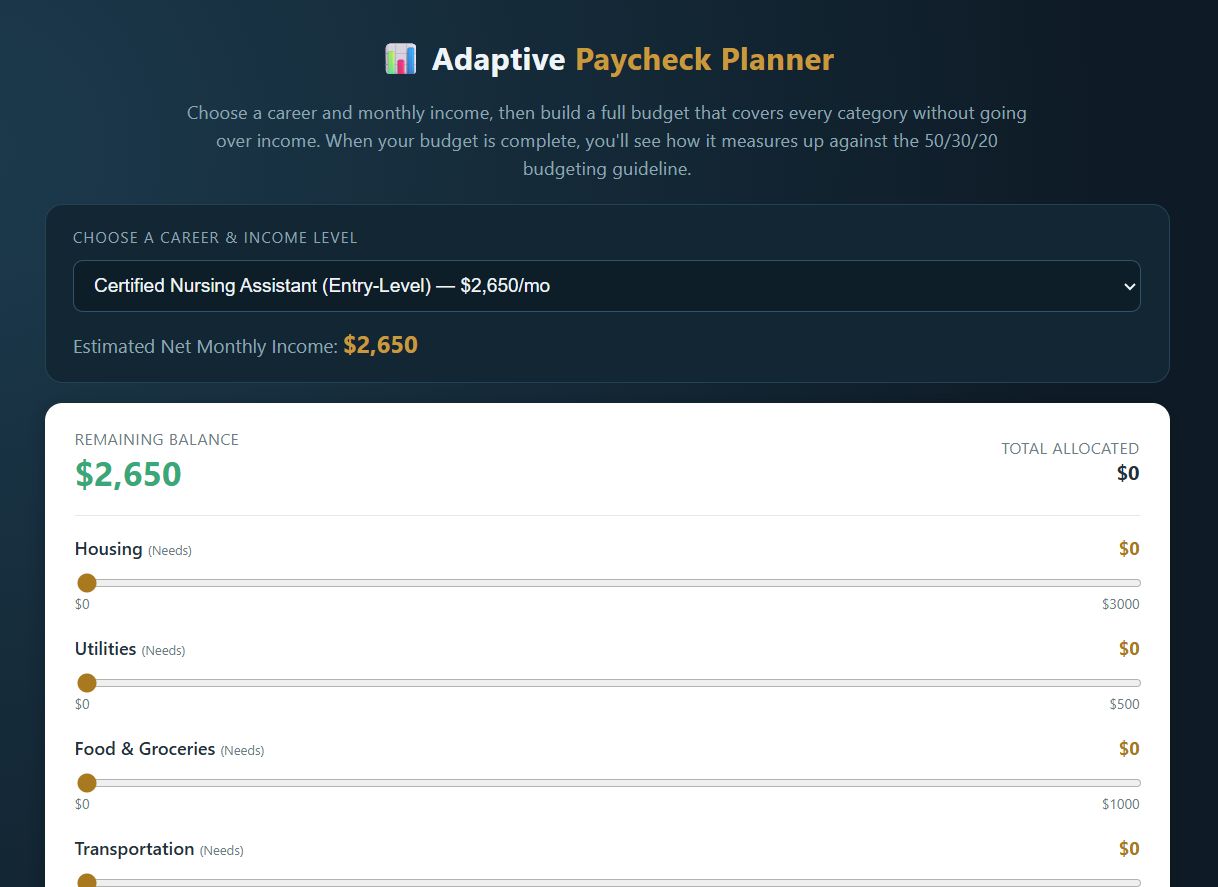
Adaptive Paycheck Planner | Workforce Development / Financial Literacy | Real-Time Budget-Balancing Simulation
Most budgeting lessons hand learners a worksheet with the numbers already decided; this simulation hands them a paycheck instead and makes them earn a balanced budget through trial and error.
Built in HTML, CSS, and JavaScript, learners select from a range of realistic career and income levels from entry-level hourly work through advanced salaried positions, then take on the role of a new earner building their first monthly budget from that income.
Rather than filling in a worksheet with predetermined numbers, learners must allocate their chosen income across eight live expense categories using interactive sliders, watching their remaining balance update instantly with every adjustment.
The simulation won't let a learner "finish" until every category is funded and the budget balances without going over income, forcing the same trade-off reasoning a real budget requires: fund savings and lose room in discretionary spending, cut transportation and free up housing, and so on.
Once the budget balances, the simulation automatically classifies every category as a Need, Want, or Saving and benchmarks the learner's actual percentages against the standard 50/30/20 budgeting guideline, flagging each group as within, above, or below target.
This turns the exercise from a math activity into applied financial planning, the same kind of benchmark analysis a financial counselor would walk a client through.
Because the income level is adjustable, learners can rebuild the same budget under a lower- or higher-earning scenario and directly compare how career choice changes financial flexibility, surfacing the connection between career pathway decisions and lifestyle outcomes without a single lecture slide.
Try it yourself: Pick a career, build a budget, and see your own 50/30/20 breakdown in real time.
-

Rapid eLearning - ThingLink + Canva
This work sample features an interactive scenario-based module developed in ThingLink and Canva, designed to build workforce readiness skills across a broad learner population from high school and college students to adult workforce learners entering or advancing in professional roles.
Learners navigate nine scenario and concept questions covering the manager role, management responsibilities, leadership styles, and how leadership directly affects team productivity and motivation. Each scenario is presented through a visually immersive character-based interface, where learners read real-world management situations and select the best response, reinforcing critical thinking and decision-making skills in an engaging, low-stakes environment.
This sample highlights my ability to rapidly design and develop interactive learning experiences using accessible, versatile tools, demonstrating that high-quality, learner-centered instruction doesn't require complex authoring software to be effective.
-

Scenario-Based Interactive
This work sample features a scenario-based learning activity developed in Articulate Storyline, designed to immerse learners in realistic decision-making experiences. Using branching interactions and immediate feedback, the module promotes critical thinking, reflection, and active engagement.
The flexible structure supports deeper understanding and empathy by placing learners in context-rich situations where their choices directly impact outcomes. This format is highly adaptable for use in simulations, case studies, or professional training modules across a variety of disciplines.
-

Microlearning
This work sample demonstrates the use of microlearning principles in online course design. Developed as a brief, focused learning experience, the module presents key concepts through visually engaging slides and layered interactions.
Its short duration, clear structure, and interactive elements support just-in-time learning and reinforce retention. Ideal for asynchronous environments, this format is effective for introducing foundational concepts, offering quick refreshers, or supporting spaced learning strategies within a larger curriculum.
-

Gamification
This work sample showcases the use of gamification in an online learning environment, developed using Articulate Storyline. Designed to boost learner engagement and retention, the activity features interactive game elements such as immediate feedback, challenge-based progression, and a visually dynamic interface.
By transforming review content into a game-like experience, this example demonstrates how instructional design can leverage motivational strategies to make learning more interactive, enjoyable, and effective. The format is highly adaptable across topics and well-suited for both asynchronous and blended course models.
-

Interactive Tabs
This work sample demonstrates the use of Articulate Rise to create an interactive tab-based design that organizes instructional content in a clear, user-friendly format. Through clickable tabs, learners can explore information at their own pace, supporting self-directed navigation and reducing cognitive overload.
This modular approach enhances engagement, encourages exploration, and improves accessibility in online course design. It is especially effective for presenting layered or comparative content and can be easily adapted for various subject areas or learning objectives.
-

Interactive Knowledge Check
This work sample features a gamified knowledge check developed in Articulate Storyline, designed to help learners review and reinforce key concepts in a self-paced, engaging format. The activity incorporates interactive elements and immediate feedback to promote active recall, repetition, and reflection.
With its clean layout, intuitive navigation, and game-like structure, this knowledge check offers an engaging alternative to traditional quizzes, making it especially effective as a formative assessment tool in online learning environments.